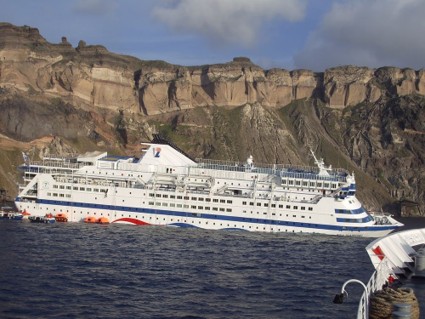
Nearly 20 years after the sinking of the SEA DIAMOND, and while the wreck remains in the Santorini caldera, new research by the Technical University of Crete seeks to investigate its environmental impact and assess the current state of the marine environment.
The programme will be carried out under the scientific supervision of Professor Evangelos Gidarakos and will include two comprehensive rounds of sampling and laboratory analyses. The aim is to determine the presence and concentrations of petroleum hydrocarbons and heavy metals in the area surrounding the wreck.
The Technical University of Crete has previously conducted long-term research in the area, documenting changes in environmental contamination through analyses of seawater, sediments and marine organisms. The new study is expected to provide updated scientific data on an issue that remains unresolved.
Furthermore, intense seismic activity in the wider area increases the risk of new fractures developing in the wreck, which could accelerate the release of petroleum hydrocarbons and toxic metals into the marine environment. At the same time, the possibility of the vessel shifting or sliding into deeper waters may also increase.
Monitoring marine pollution is essential, but it does not constitute a definitive solution. Addressing the problem remains closely linked to the need to remove the wreck from the Santorini caldera, a position that has also been highlighted by the Greek judiciary, including the Supreme Court of Greece and the Council of State.